


Unhurried Radio: Teaching 868 MHz LoRa Mesh Not to Rush (WadaMesh)
On this page (3 sections)
When you send a short sentence six kilometers from a forested ridge to a valley floor using half a watt of 869.525 MHz radio and zero infrastructure, your first feeling is quiet wonder. Ten minutes later, when three friends try to reply at once and every packet vanishes into collisions, the radio teaches you something fiber-optic internet made us forget: silence is half of communication.
While building wadamesh and meshcomod, we had to unlearn almost every impatient habit of modern chat UIs.
Sitting With Half-Duplex Physics#
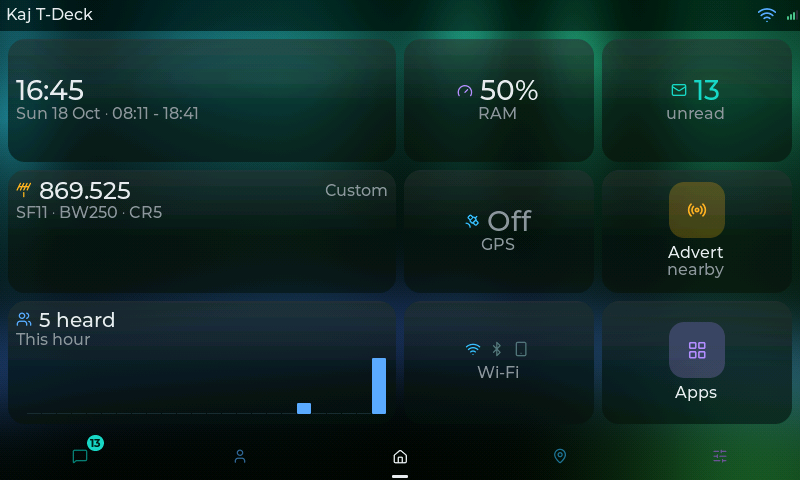
In a normal web app, if an acknowledgement doesn't come back in 200 ms, you retry. On LoRa at SF11 · BW250 · CR5, a single frame hangs in the air like a long bell note. While a repeater on the ridge is forwarding your message to the next valley, its receiver is deaf.
In our earliest field test, we hid those slow radio mechanics behind a generic "sending" spinner. Whenever an ACK took four seconds, our own thumbs got anxious and tapped Send again — stepping directly on top of the ridge relay that was faithfully forwarding our first message. Our impatience was literally jamming our own path.
Three Bottlenecks That Shaped the Tool#
1. Replacing anxious retries with airtime-aware breathing room#
Once we stopped treating radio delay as an error, the fix became obvious. Instead of blind fixed timers, WadaMesh computes the actual symbol airtime of the current spreading factor and leaves unhurried, randomized silence windows so relays can finish speaking before a handset ever retries.
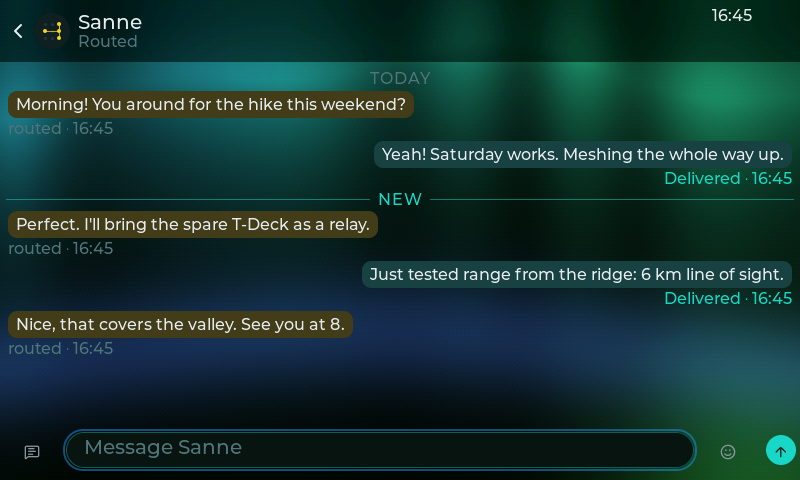
Just as importantly, we made the UI tell the simple truth (queued -> on-air -> routed -> delivered). When people can witness the packet moving step by step across the ridge, they relax and stop mashing the button.
2. The 2:34 AM false-low-battery mystery during TX bursts#
On November 12 at 2:34 AM, we finally caught a bug that had been making handheld nodes cry wolf in the cold. Every time the radio keyed up a +22 dBm transmission burst, battery impedance caused a brief 180 mV sag. Our naive ADC loop sampled right inside that transmit window and flashed a scary low-battery warning on a pack that still had 70% charge left.
Holding battery telemetry sampling quiet during TX ramps — and adding unambiguous charging/state icons — turned a jumpy gauge into a calm, trustworthy reading.
3. Letting the phone sleep without losing the thread#
Nobody hikes with an unlocked browser screen glowing in their palm. Whenever iOS or Android suspended the companion tab, WebSerial/BLE dropped and earlier builds wiped the visible session. Moving the canonical ring buffer onto the radio's own non-volatile flash — and reconciling only missing sequence numbers into IndexedDB upon waking — meant your phone could stay in your pocket where it belongs.
Step-by-Step: Trying WadaMesh on Your Desk or Ridge#
You don't even need radio hardware on day one — we built an honest local simulator mode so you can feel half-duplex routing on your laptop first.
Step 1: Clone WadaMesh and launch the local companion UI#
git clone https://github.com/TinkeringDao/wadamesh.git
cd wadamesh
npm install
npm run dev
Step 2: Watch multi-hop timing in Demo Mode#
- Open the local localhost URL in Chromium or Safari and tap Demo in the top bar.
- Send a message in a simulated thread and notice the deliberate pause between
on-air,routed, anddelivered.
Step 3: Pair a physical 868 / 915 MHz LoRa node#
- Plug an ESP32-S3 or nRF52840 + SX1262 / LR1110 node into USB-C.
- Tap Connect (
115200 baudWebSerial) and configure your regional sub-band (in Europe,869.525 MHz,SF11,BW 250 kHz,CR 4/5). - Keep GPS toggled
Offto save~30 mAunless you need a single location fix, then tap Advert nearby once and give the airwaves a few quiet seconds to answer.
An empty channel isn't wasted bandwidth. Like the hollow inside a clay cup, the quiet space between transmissions is the very thing that makes the mesh work.